When Will the Joy Come? Black Women in the Ivory Tower

Speech at Brookhaven Fire Department Protest 8/2/20

“I want to acknowledge all of you who came out here today to affirm the idea that there is no home for hate here, specifically that the Confederate flag should have no place on our fire trucks, no place in our fire department drill teams, and that our beloved  first responders, who are here to serve everybody at our moment of greatest needs, should not be defending or making excuses for displaying the Confederate flag in the course of their duties.

So I honor you for standing up to say this, for affirming the fact that there should be No Home for Hate here.

I want to also acknowledge the Brookhaven Fire Department who have put out two public statements apologizing for this display. Just today the Fire Department released a statement saying that they would be undergoing implicit bias training and that the persons most directly involved in this incident will be placed on suspension pending investigation

I commend the department for taking these steps, I really do. But I want to talk about what else needs to happen and why.

About three years ago, we found that the Holbrook Fire Department website had the Confederate flag all over it. The drill Team, had as their icon an image of General Robert. E. Lee holding the Confederate Flag and a Sabre. The website talked about how members of the squad, (folks who are still on the squad today) I might add,  in were handpainting images of the Confederate flag on their drill team helmets. This iconography was proudly displayed as part of the Holbrook Fire Department’s history. 

So about three years ago, we brought this to the Holbrook FD. We reached out to them, asking them what is the relationship between this department and the Confederate Flag? Why is this the icon that they deemed appropriate for their drill team? 

Are you aware, we asked them, that the Confederate Flag was created by the Southern states that broke away from the Union in the 1850s,  primarily over the issue of the enslavement of African people. Let me be clear: this was the flag of people who believeed that the enslavement of folks of African descent, people like me, should be continued and preserved, far into the future.

When the state of South  Carolina seceded in 1860, it explained clearly why it was breaking away from the union.  It did not speak about the tariff, or about states rights. It broke away, under this new flag ,”due to the increasing hostility on the part of non-slaveholding States to the institution of slavery” and the because of the election of a president, Abraham Lincoln, who believed “that slavery is in the course of ultimate extinction.” This, clutching on to slavery, is why the Confederate flag was flown, and what was at the center of the Civil War.

Are you aware, we asked the Holbrook FD, that the Confederate Flag was revived in public life in the 1950s when the civil rights movement began making headway and pressing for an end to Jim Crow in the South?  This flag reappeared in national public life in a big way when President Harry Truman desegregated the U.S. armed forces and supported anti-lynching bills? This was the time in Missisippi people began waving the Confederate Flag and putting it up — it was a way to signal their oposition to the federal governments efforts to remove racism, racial exclusions and violence from the infrastructure of public life!

We brought this all to Holbrook Fire Department. Why are you flying this flag? When did this come to be the icon of your drill team? Why have other fire departments all throughout Long Island, never said a peep, about this issue. They see the flag flying, they see the helmets, they see the icons, when and why is this Confederate flag a part of fire department culture? We brought this all to them.

We HARDLY. COULD GET. A RESPONSE. 

We were fluffed off, told it was a personnel issue, and a misunderstanding, and the webpage was scrubbed. That was it. And here we are three years later.

So no, at this point, we are not going to accept that this was an isolated incident, an individual error, or a misunderstanding.

There is a relationship between Long Island’s Fire Department drill teams and the Confederate flag. This relationship is well-documented by the Frie Departments thesmelves. So we want to know: what is this about? When did these drill teams take on the Confederate flag as their icon and why? Has anyone from within spoken out about this, if not, why not? This is the investigation we are looking for, not one focused on a lone individual who made a poor choice, but one that dares to be honest about the reality that all is not well. 

No amount of implicit bias training will be sufficient to sidestep this very explicit history where a symbol of hate, of holding on to slavery, of holding on to  Jim Crow, has been been part of the culture of Long Island drill teams.

So before we can accept the apologies and the implicit bias training and the feel good slogans, please, let’s have the truth. What is this about? When we know what this relationship is and has been, we can talk then more honestly and in a more informed way about what type of changes are necessary to heal this breach and set a new course. 

And lastly, I want to talk about why this is not a trivial matter. Because of the kids. I am standing here for all the little girls and boys whose eyes light up with excitement and pride when the fire department trucks roll through. I’;m here for all the little girls and boys who look to the dire department and see heroes, whose first understanding of public service comes from this vision that there are people who sacrifice their time and their safety to help others in their hour of need. We owe it to these chidlren to do better and to demand better.

I’m very sorry this has happened, but now that it has, we have to make sure it never happens again. Let me be clear:  on Long Island, we do not want to see first responders, fire department trucks, flying the Confederate Flag on the street, at their drill team events, or on their webpages. And if there are people who are in these units, who cannot give this flag up, who cannot honor a fallen brother without waving this flag, who believe that this is such a part of their culture that they cannot do without it, those people need to do something else. We have to get to the root of this and decide that all our communities matter, all our children matter, and that right is always right.”

William Floyd Must Fall! Chanting Down Monuments to Violence in Eastern Long Island

Photo credit: WISTFUL HEART STUDIOS™ https://wistfulheartstudios.com/


At a busy intersection in one of Long Island’s most diverse communities, a statue of William Floyd stands. In Mastic, New York, William Floyd’s name is ubiquitous; it marks a major thoroughfare and the local high school. Shirley, an adjacent town, even considered rebranding itself as Floyd Harbor in the 1980s in order to burnish its image. The William Floyd statue has been standing on the corner since 2013, but for how much longer? During this summer of racial reckoning more than three thousand people signed a petition calling for the statue to come down. A counterpetition bearing a similar number of signatures insists that the William Floyd statue stay exactly where it is.

New battlefields are emerging as the chant Black Lives Matter comes to the suburbs and rural communities. In a country where anti-Blackness is stitched tightly into the national fabric, wherever the march route ends, there is always much more work to do. In Eastern Long Island, this summer’s Black Lives Matter marches lead directly to the base of the William Floyd statue—among other places.

William Floyd was the only Long Islander to sign the Declaration of Independence. He risked life, land, and liberty to support a revolution that upended the 18th century British empire. William Floyd was also, from cradle to grave, a slaveowner and a land-grabber. The monument honoring him was erected in Mastic not in 1850, or even in 1920, but in the year 2013. This is a 21st century monument, installed on municipal land, with the support of the Suffolk County government. That no elected official questioned the propriety of installing a statue of slaveowner in the middle of a diverse community illuminates a simple reality:  memorializing William Floyd in heavy metals is a question of who has power and place.

There is little disagreement about the facts of Floyd’s life in late eighteenth/ early nineteenth century New York; it is the meaning of this history that is contested. The Floyd plantation was built on the dispossession of the Unkechaug people from their land and the enslavement of African people. These acts of violence were heritage for William Floyd.  According to Brookhaven Town records, his great-grandfather, Richard Floyd I, was buying and selling enslaved people in 1672. Young William inherited captive Africans from his father and also bought others. Ten years after signing the Declaration of Independence, William Floyd “purchased a boy named Philip.” It was never a truth self-evident to William Floyd that many of those around him– the Unkechaug “servants” that his family kept in a tight web of control and the enslaved Africans on his plantation—were deserving of any measure of freedom.

By 1790 when many of his local peers opted to emancipate their captive Africans, according to the Federal Census, William Floyd held 14 people in bondage; he was the largest slave owner in Brookhaven town. Beyond the particular individuals (known only by first name in his ledger) held on his plantation, William Floyd’s fortune was deeply entangled with “the peculiar institution.” The Floyd plantation was a node in what historian Jennifer L. Anderson calls “the Atlantic plantation complex”:  enslaved Africans working on Long Island plantations produced wheat sold to Caribbean plantations in order to feed enslaved Africans producing sugarcane for the “insatiable grinding mills.” William Floyd’s relationship to slavery is not a matter of the burial sites or the diets of the people he held in bondage until their last breath; slavery was the lifeblood of his livelihood, wealth, his political standing.  Simply put, William Floyd was not a champion of freedom for all of us.

By way of excuse, statue supporters say that William Floyd was a man of his time — which is a way to not say that William Floyd was a white man of his time. More precisely, to not say that William Floyd was a white propertied man of his time whose wealth and political status depended on owning the bodies and futures of other men and women of his time.

In saying that William Floyd was a man of his time they do not say that there were other men in this time. Floyd’s time was also the time of Denmark Vesey, an enslaved man in South Carolina who plotted a rebellion to burn the plantation economy of Charleston and its plantocracy to the ground. Denmark Vesey also had something to say about freedom.

William Floyd’s time was also the time of Elias Hicks. Born within 50 miles and ten years of Floyd, Elias Hicks was a farmer, landowner, and Quaker who became an abolitionist. At the age of thirty, Hicks began to free the human beings he held as captives and spent the rest of his life preaching, teaching, and writing against the evil of slavery in America. Hicks insisted that an economic strategy, a complete boycott of slavery-associated goods, was needed to topple slavery.  On his deathbed, it is said, Elias Hick insisted that no cotton blanket, a product of slavery, should be used to cover his body for warmth or as a shroud. Elias Hicks was also a man of this time.

Those who insist that William Floyd be venerated are wedded to the notion that African enslavement and indigenous dispossession are collateral damage in a grand and glorious narrative of (white) American achievement. In this narrative, the success and wealth of Europeans and their descendants matter more than the lives of others. This, by definition, is a racist ideology.  “They teach us that, yes, he was a slave owner, but he did all these other great things. He’s presented as this complex hero. And if you feel some sort of way about that, you’re the problem. It’s like we are being gaslighted.” So says one the organizers supporting the statue removal. But slavery was not just an unfortunate detour on the road to the Declaration of Independence. Slavery is violence; the destruction of families, rape, forced labor, branded flesh sizzling, the ocean saltiness swallowing up generations. Settler dispossession of indigenous land was not an unfortunate historical outcome. It is genocide, the destruction of whole clans, histories, and knowledge traditions; it is a child’s brain matter smashed against rocks. The impulse to justify this violence as necessary, even heroic, is exactly what must be torn down, brick by brick, and word by word.

‘Where does it end?’ critics of the statue’s removal demand. ‘What will happen if we stop idolizing purveyors of racist violence and justifying their ideologies?”  Well, hopefully we will build a more perfect union! Antiracism, in the late twentieth/early twenty-first century, is, too often, a dish best served lukewarm. Ours is a society reluctant to depart from the institutions and traditions bequeathed us by violence even while fervently professing a desire for healing. In this country we stand as pillars of salt, facing backward frozen while seeking forward motion. Chanting down statues is not a substitute for legislative, economic, or political transformation, but we should not underestimate this powerful ritual. Breaking the idols to racism that casually dot our public landscape is an act long overdue. When the William Floyd statue in Mastic falls, it will not end the legacy of this or any other “founding father.” It will be a beginning. Statue removal, as much as statue erection, is a public history act; it is a way to burrow deeper into a complicated national past and make sense of it, together.

Click HERE for more information about the William Floyd Must Fall Vigil & Protest on August 22, 2020 in Mastic, NY. 


Reflections at Stony Brook University Town Hall, June 18, 2020

On this eve of Juneteenth I’m sharing the video of my remarks at a Stony Brook University town hall about systemic racism. The text follows:


My name is Abena Asare and I’m Associate Professor of Africana Studies and History in the Dept. of Africana Studies.

We meet today in the midst of an uprising against state-sanctioned violence targeting Black and African American people in the United States. This uprising is focusing on transforming systems of racial violence and the individuals and institutions that defend, benefit from, and justify these systems. This is an uprising watered by the blood of Black folk, Black trans people, men women and children who have been lynched at the hands of the state. We sit in the shadow of families and community members who have HAD to organize, and march, and protest and give public statements, in the midst of their mourning.

So we say their names! Rayshard Brooks, Maurice Gordon,  Tony McDade, Elijah McCain, Sandra Bland, Philandro Castile, Breonna Taylor, Eric Garner, Mike Brown, Korryn Gaines. We say their names to make the state’s violence visible. We also say their names because each of these losses ruptured a whole world; these were unique, inividual human beings who were relatives, mothers, friends, loved ones. Each is irreplaceable. These are not hashtags or bodies, each of these precious ones was someone’s whole world.

Even as we say their names we realize that we cannot finish; the list is just too long. Those cut down explicitly and covertly by our state keep coming even as we weep, and get our degrees, hold our zoom meetings, and raise our children in fear and hope. This problem of state lynching which is a manifestation of society’s investment in morbid anti-blackness is not a matter of a few bad apples on the police force, or a particularly sympathetic victim, a particularly brutal death; we are speaking today about the routine, deadly violence that has kept the wheels of this country’s economic and political system churning as it has for the past 400+ years. What does it mean to say a enough! Enough already.

We begin by taking stock of where we are.  I need to acknowledge the decades of organizing and labor that have led to this current moment. We need to know that the Black Lives Matter movement, founded by 3 Queer Black Women n 2013 is a reclaiming and reignition of the Black Freedom Movement that extends back to the 1970s to the Black Panther Party, to  SNCC, the Student Nonviolent Coordinating Committee in 1960,  to Ida B Wells and her campaign against lynching in the 1920s, to Frederick Douglass who asked in the 1850s what to the slave is the 4th of July, a question that fundamentally is not about where Black people fit into the nation, but really about where the United States fits into the annals  of global inhumanity.

So where are we?  In the past three weeks, the Minneapolis City Council voted to disband the city’s police dept and instead fund public safety system.

The University of Minnesota has also  severed all ties with the police department.

Increasingly, folks around this nation are willing to acknowledge that pouring money into  police state, does not make us safer, but that it does make the country more unequal and definitely more deadly for Black and Brown, poor, and disabled folk. More people around the country are beginning to step towards a realistic vision of public safety.

This past Saturday, 15,000 ppl marched through Brooklyn to protest this state’s violence against Black trans women who face disproportionate levels of harm both at the hands of police in the streets.

Racist statues are tumbling into the sea, pulled by the hands of people who believe that we need other iconography, others images for our public spaces.

At the same time, over these past week, we have seen police assaulting protestors in our urban areas.  We are living through a time where police are pepper spraying crowds of protestors in the midst of  a deadly virus that specifically attacks the human respiratory systems.  This should be considered a crime of war and must be stopped immediately.

What I’m saying is that this fight is far from over; this is not the time for platitudes and complacency. Not at all.  This is a moment when each of us, individually and corporately are being invited to take a look at our power, where did we get it from, what is the nature of the power that we hold, and what do we want to do with it.

Which brings me to Stony Brook and to this meeting today. We should be clear about on thing. Many of the institutions that have been quick or slow to release statements declaring their support for Black LiVes  have yet to do anything at all to address the  systemic racism that plagues their institution. And no a panel, or a town hall does not count as something.

It may be convenient to wring our hands about about George Floyd, but we must acknowledge that there is a man called Akbar Rodgers, a Freeport, LI man, not too far from here, last December 2019, who was beaten and assaulted within an inch of his by the police in Suffolk County. We have to acknowledge Jeffrey McClure a 26 year old man who was shot and killed by the police in Northport just a few days when his father called 911 for psychiatric help.  In Suffolk County, black and brown people make up just 17% of the population, but account for 53% of felony arrests. In fact, the US Justice Dept is currently reviewing Suffolk’s record of traffic stops and race because the data is so egregious. (I want to thank Nia Adams of the Long Island Progressive Coalition for some of these statistics). So what is Stony Brook University’s relationship to the Suffolk County PD? Stony Brook is the largest emplyer, the economic hub of the region, what does it mean for our institution to lead in saying our budget and our practices should reflect our values?

When university release these  Black Lives Matter statements  we must ask how these relate to the ongoing “reopening plans” that do not take into account how Black and other communities of color are being affected by the COVID 19 epidemic. My colleagues Joseph Pierce and Odalis Hernandez in the UUP have written an open letter insisting that the question of reopening and how it is done IS a racial justice issue, is an equity issue, and that we must protect the most vulnerable members of our community as we make these plans. I would encourage you…

As we wring our hands about George Floyd we would do well should consider our own university’s links to prison labor. In 2019, Stony Brook University and the hospital spent nearly 40,000 on prison-made goods. Thanks to historians Rob Chase and Yalile Suriel for these numbers. Our institution is tied up in our national nightmare of racial violence. The question is what are we willing to do about it.

So

The cry Black Lives Matter is not only about the police as an isolated institution; the cry Black Lives Matter is looking at systemic racism and the way it is reproduced and protected and furthered by a number of institutions across society. This country, has historically, in law and in practice, valued property and wealth, and the need to defend these, more highly than it has valued the lives of many of us within its borders–specifically Black, Brown, and indigenous folk. In a country located on stolen land, built through stolen labor, the cry Black Lives Matter in 2020 is a call to do the necessary work of imagining and pursuing a future that is not forever trapped within our violent racialized national history.


Food Crisis in Suffolk County, NY


People from all walks of life are being hit hard by the COVID crisis. Many in our communities are seeing their income drastically reduced, losing their jobs, and/or facing health crisis with attendant financial costs during this time. Individuals and families throughout Suffolk County are struggling to secure food. Some in our communities do not have the means to buy food for themselves  and their families. Others may have the means to purchase food, but due to age, health status, illness, pregnancy, transportation difficulties, distance from stocked supermarkets, federal restrictions on using SNAP benefits for delivery costs, and other factors are unable to secure the necessary food.

Historically marginalized communities are facing disproportionate harm in this public health emergency. Throughout Suffolk County, indigenous, African American, Latino, immigrant, low and fixed income, undocumented, and elderly communities, among others, are facing particular hardship because of already existing vulnerabilities in our nation’s social services, labor, and health systems. Homeless and unhoused persons, as well as families with disabilities face new obstacles in their ability to secure food and medicine. As a region with high levels of income inequality, and a history of racial and economic segregation, Suffolk County’s disparities may be deepened because of the COVID crisis.  The temporary closure of schools, churches, non-profits and other key community institutions has left many families increasingly dependent on a limited and shrinking set of networks for access to necessary goods and services—including basic nutrition.

In our region, the COVID-19 crisis has put unprecedented stress on our emergency food aid systems. Food pantries and food banks throughout Suffolk County are facing overwhelming amounts of need and continue to issue urgent calls for donations and volunteers. School districts throughout Long Island have become emergency food access points by providing “grab-n-go” lunches to ensure that families who rely on freed and reduced breakfast and lunch continue to receive nutrition throughout the unprecedented period of school closure. New networks of mutual aid have sprung up throughout the island to respond to this reality, and diverse community organizations have had to quickly take up the problem of food aid because of the urgent levels of need among their members and clients.

We have been heartened and inspired by the heroic efforts of long-established organizations and newly developed mutual aid networks alike. There have been generous outpourings of donations of money, time, and food as people throughout Suffolk strive to take care of another.

AND YET, existing systems are not sufficient. We have seen the pictures of the long lines of cars wrapping around block by block when food pantries have sporadically offered drive- by pickups. We know that individuals take risks when they entrust their EBT cards to others for shopping because SNAP benefits cannot be used to pay grocery delivery fees. We know that many people with disabilities are unable to wear the masks required in public shopping establishments and unable to wait on queues to receive food. We know that many in our communities are unable to navigate the process of finding a food pantry that is open, speaks their language, and can meet their needs. We see people involved in mutual aid efforts contract COVID-19 and sicken as they serve their community.

We do not know how long it will be until Suffolk County is open for business once again. We do not know how long our public and private schools may be closed or what types of shelter in place, quarantine or isolation policies may be enacted to protect human life in our area. Without maintaining adequate nutrition for all throughout this crisis period, the eventual recovery that will come to Suffolk County will leave large swaths of the community behind.

Local food and justice advocates call upon county, local, and regional governments to work together to implement an emergency food aid delivery system in Suffolk County. It is prudent to implement and publicize this capacity now, knowing that foresight, preparation, and community participation will be critical to the efficient function of any such initiative.

Sign here to join our petition for a county-wide emergency food hotline.

A Tale of Two Parks in Accra


Efua Sutherland Children’s Park in Accra this day is almost deserted. Under the pavilion, a wonderful woman has organized a “soup kitchen” program for street youth who are gathered together to receive words of wisdom and a meal. Otherwise, this large green space at the center of Accra’s hyper-congestion is almost empty. Brilliantly colored dragonflies and butterflies dart and flutter among rusted metal playground structures on which no child dare step: sharp edges are everywhere, spikes abound, corroding metal curls away from all surfaces in threatening shards and whirls.

The brightly-patterned ferris wheel and the deserted children’s train that once ran around the park add to the post-apocalyptic scene: you can almost hear the laughter of long-ago children, the shouting and carrying on of Accra youth about to vacate school. Where have the bodies of children been snatched to? What alien force has taken them from the 12 acre park that was named for them? What is going on with Efua Sutherland Children’s Park?

And still, my children play. The broken beer bottles do not prevent them from racing across the field; the train without a floor is still fascinating. There is still magic and invitation here.

Later on in the day we go to Mmofra Place, a park and playspace created by the Sutherland family foundation in Dzorwulu (Abelenkpe Road, next to Marvels). Immediately, the kids are off running, whooping and hollering in a space that has been curated just for them. Here, there is no worry– everything in the eponymously named Mmofra Place is designed with children in mind. The treehouse, climbing wall, jungle gyms, drama stage, wooden motorcycle and more invite children to run, touch, dream and commune with the natural world. We watch lizards and talk about the gardening boxes. In the majestic treehouse the kids come up with a complicated game suspiciously resembling a Nollywood plot. Mmofra Place’s comparatively low entrance fee of 5GHC per day reflects its sense of mission: young couples can stroll the well-kept grounds, people might picnic, exercise, meet, and just breathe free in a place of beauty.

The distance between the Efua Sutherland Children’s Park and Mmofra Place is substantial. One is public (albeit currently inaccessible), the other private. One is in woeful disrepair, the other strikingly lovely; but both are connected by the name and personage of Efua T. Sutherland, the artist, creator, and institution-builder who believed that all Ghanaian children (and perhaps their parents, leaders, and politicians) need green spaces to play.

In the 20 years surrounding national independence (1947-1967) Efua T. Sutherland was a secondary school teacher and a children’s book writer. She also founded the cultural journal Okyeame, started the Experimental Theatre Players in Accra, founded the Ghana Society of Writers, (later the Writers Workshop at the Institute of African Studies) and created the touring theater group Kusum Agoromba. In 1997, the public park across from the National Theater was named after Sutherland to honor her advocacy for Ghanaian children whose needs, she insisted, were a true north in the project of nation-building.

More than 20 years later, the blightedness of the Efua Sutherland Children’s Park is a problem hiding in plain sight. There  have been articles and blog posts aplenty mourning this display of dilapidation at the center of Accra, but nothing is being done. What is going on with Efua Sutherland Children’s Park?

A few years ago the previous government was involved in negotiations to sell these twelve acres to be “developed.” Questions raised by the Sutherland family prevented the loss of this national public resource. Since then, the Children’s Park has been very much left alone- the government has not rubbished the rusted play equipment that makes the place a hazard; the benches remain broken, the prohibition on public use is there.  Only organized events– funerals, festivals, political rallies can come there. The generation of children growing up now will have no positive memories of playing in the Efua Sutherland Children’s Park, of strolling from there to the National Theater, of darting around the center of their Accra on a plot of land preserved for them.

And on some level, perhaps this is the point. The continuing neglect strengthens the hand of those who look at this 12 acres and see only dollar and cedi signs; only hotels or malls, more large private concrete buildings jockeying for space in the sky.  When there is no-one who remembers what Efua Sutherland should be and once was, the process of selling it will be that much easier.

The government sits on its hands and shrugs, insisting that it cannot manage a simple park. This, then, becomes yet another sector of Ghanaian life that appears to only work when it is privatized, outsourced and set to a fee.  This willful neglect– to the degree that it sets the stage for the sale and loss of one of central Accra’s only green public spaces—is more than child’s play.  Government’s refusal-to-steward/willingness-to-sell cultivates this mantra where the only good Ghanaian future is a privatized Ghanaian future.

Part of the triumph of Mmofra Place is that at every stage, in name and vision, it references the Efua Sutherland Children’s Park. The practical beauty of Mmofra Place juxtaposed with the deliberate dilapidation across town forces the question:  so what is going one with Efua Sutherland Children’s Park?  The new site, spearheaded by the Sutherland family, is a creative act of institutional optimism. It does not solve the problem; it should not let the government off the hook! However, this project recognizes that  children (and adults) have to experience what they’re missing to know what to work towards, what can be possible. Mmofra Place is a seed, a lesson. It is reproducible and inspirational; it is nourishment. It preserves Efua Sutherland’s dream (which was always public, for all Ghanaian children) even in our time.

This also should be named: the ongoing neglect of the Efua Sutherland Children’s Park is the attempted erasure of a Ghanaian women’s brilliant contribution to the content of national independence. Given the current administration’s focus on expanding the public memory of the independence era, it is surprising that this assault on the legacy of a visionary foremothers continues. Any child will tell you that unless you learn to respect the voice of your mother, you will never be happy. So we must ask, as many times as is necessary, what is going on with the Efua Sutherland Children’s Park?

My gratitude to all who provided feedback and insight.

For the Salon…..

“the healing and repair work of several generations”: the Ghana National Reconciliation Commission (NRC) in a global reparations movement


What are Truth and Reconciliation Commissions (TRCs)?  

Over the past three decades, truth and reconciliation commissions (TRCs) have been established in times when courts are unable to confront past violence and places where the scale of harm dwarfs the capacity of traditional punitive models. Diverse histories of violence, including the Liberian civil war, the Indonesian occupation of Timor-Leste, South African apartheid, and the Indian Ocean slave trade, have passed under the TRC microscope.

TRCs are based on the premise that investigating historical violence (seeking the truth) can be done in such a way as to clear the path toward healing (reconciliation). Provision for reparations have come to be a standard part of TRCs as ‘victim-centered’ processes.  As extra-judicial instruments, TRCs recognize the inadequacy of punitive criminal justice in dealing with the violence reverberating within our modern world. And yet, TRCs have historically been established as “transitional justice” instruments, that is, as part of a neoliberal democracy-building framework that pursues versions of stability and peace as defined by the UN and related power centers in the international order. TRCs attempts to move beyond criminal justice have conventionally been quarantined to “other” nations, countries in the Global South. Thus the TRC’s efforts to push beyond the insufficiency and violence of punitive criminal justice remains quarantined in a Eurocentric framework: it may be good for those other places, but not for us.

In the past decade, communities in wealthier nations have begun to embrace and apply the TRC as a way to confront historical injustice. The Maine Wabanaki-State Child Welfare TRC (2012) and the TRC of Canada (2008), both focused on violence against indigenous/ First Nations populations. The Greensboro TRC (2004) and the Alachua County TRC (2018) focus on racialized violence against African American populations in the US. These, among others, speak to this ongoing effort to wrest the TRC from the transitional justice framework and apply it within a more robust historical justice movement.

What was the Ghana National Reconciliation Commission (2001 – 2004)?

In 2001, the Ghanaian government established the National Reconciliation Commission (NRC) on the heels of the first electoral regime in Ghana’s national history. Political negotiation led to an expansive mandate. All the years from national independence in 1957 until the democratic constitution of 1992 were up for review, and the NRC used a broad definition of “state-sanctioned human rights violations” as its mission. Approximately 4,300 Ghanaians out of a country of 20 million came forward with stories of violence. A proportion of these were invited to testify at the public hearings, also held in different regions throughout Ghana and widely publicized by the media. Consequently, the NRC Commissioners penned a final Report reflecting on the process and making recommendations for reparations. By 2007 approximately 2000 Ghanaians received reparations payments ranging from $217 to $3,300 based on the abuse that they suffered. This reparations program was seen as largely unsatisfactory by the participants in the NRC, and was by many accounts with self-described victims, a source of bitterness.

The reparations program that the Ghana government implemented diverged from the reparations program in the Commissioners’ Report. Likewise, the Commissioners’ recommendations for reparations also did not match the shifts that survivors of violence publicly longed for in their petitions and testimonies.

Three Lessons from the NRC about Reparations   

Lesson # 1: Reparations programs developed as part of global TRCs have often been paltry, focused solely on small sums of money or other token gestures—and divorced from what survivors actually ask for. These anemic programs then shore up the perception that reparations “cannot work” or “can never be enough” or “are not worth fighting for.” Reparations program must center the survivors of violence as experts– not only seeking their testimony, but also in the design and implementation of the reparations program.

Lesson #2: Survivors will have different priorities and demands in the pursuit of healing after state violence. Reparations program must account for the diversity of desire among survivor communities/.

Lesson #3: Pursuing transformative justice through reparations cannot occur solely with the delivery of particular goods to victimized communities. Without also addressing the transformation of the surrounding perpetrator society, reparations programs risk leaving the vectors of harm intact.

A robust approach to reparations is the first step in what will ultimately be the ‘healing and repair work of several generations.”[1]


[1] Moses Chrispus Okello et al., Where Law Meets Reality: Forging African Transitional Justice (Pambazuka Press, 2012).

New Article: Pursuing the Horizon of Abolition

This week my article “Pursuing the Horizon of Abolition,” was published in the International Journal of Crime, Social Justice and Democracy.  Within, I argue that African countries are not just places afflicted by the global incarceration imperative, they may also be sites from which to chant it down.

It is serendipity that this article was released just a few days before Ghana’s 62nd anniversary; its subject is the unfinished business of national independence in Ghana — specifically where prison reform and penal abolition fit into this ongoing project of African freedom.

This article is inspired by the amazing work being done by award-winning Ghanaian journalist Seth Kwame Boateng of JoyFM—- specifically two powerful documentaries about Ghana’ prison overcrowding crisis.  The links to Locked and Forgotten (2015) and Left to Rot (2016) are posted below: please take the time to watch, follow Seth Kwame Boateng, and support his ongoing work.

All interpretations, readings, and errors in the article are mine and mine alone.
Locked and Forgotten (2015)
Left to Rot (2016)

Book Award Announcement

I am so honored that Truth Without Reconciliation has been named a 2018 Outstanding Academic Title by the American Library Association Choice magazine.

“Every year in the January issue, in print and online, Choice publishes a list of Outstanding Academic Titles that were reviewed during the previous calendar year. This prestigious list reflects the best in scholarly titles reviewed by Choice and brings with it the extraordinary recognition of the academic library community.

The list is quite selective: it contains approximately ten percent of some 6,000 works reviewed in Choice each year. Choice editors base their selections on the reviewer’s evaluation of the work, the editor’s knowledge of the field, and the reviewer’s record.

In awarding Outstanding Academic Titles, the editors apply several criteria to reviewed titles:

  • overall excellence in presentation and scholarship
  • importance relative to other literature in the field
  • distinction as a first treatment of a given subject in book or electronic form
  • originality or uniqueness of treatment
  • value to undergraduate students
  • importance in building undergraduate library collections

The Choice Reviews feature on Truth Without Reconciliation is found in the December 2018 issue.

“This fascinating work explores the thousands of testimonies collected by the truth and reconciliation commission (TRC) in Ghana in 2003 and 2004. Asare (Africana studies, Stony Brook Univ.) critiques the limitations of the reconciliation framework that gained popularity after the South African TRC of the 1990s. Rather than simply deflate the pretensions of individual testimony and national healing, however, this study takes on the challenging task of constructing narratives from the widely divergent collection of statements by victims of political violence since Ghanaian independence in 1957. This allows Asare to explore how ordinary Ghanaians, soldiers, and civil servants negotiated with political authorities. Ghanaians appropriated human rights rhetoric not to support a general notion of national unity. Instead, they raised a wide range of individual concerns about matters ranging from the ways soldiers targeted female traders as traitors to the nation to the ambiguous position of the military itself, since many soldiers became victims of military regimes. Deftly drawing from a broad range of critical theoretical approaches, Asare’s study is a model for its methodology and organization. Truth without Reconciliation should be required reading for anyone interested in national reconciliation programs.

–J. M. Rich, Marywood University


Summing Up: Essential. Upper-division undergraduates through faculty; general readers.”


http://www.ala.org/acrl/choice/outstanding

Is it Time for a U.S. Truth and Reconciliation Commission?

I wrote a blog post for the Penn Press Log about the potential of a U.S. truth and reconciliation commission. 

Today, we have a guest post from Abena Ampofoa Asare, who teaches Africana studies and history at Stony Brook University and is author of the new book Truth Without Reconciliation: A Human Rights History of Ghana.  In this post, Asare draws upon her research to examine the relevance of calls for a truth and reconciliation commission in the United States today.

Is it time for a U.S. truth and reconciliation commission?

The calls for a truth and reconciliation commission (TRC) on U.S. soil are mounting. Last year, the New York State Poor People’s Campaign’s “Truth Commission on Poverty” collected testimonies about economic hardship in one of the wealthiest states in the nation. In 2013, Ben Jealous, then of the NAACP, suggested that a formal TRC process might be necessary to investigate lynchings in the US South, the criminalization of Black liberation movements, and other unresolved histories of racialized violence. In December 2015, the Lakota People’s Law Project launched a campaign to establish a TRC about the 1869 Indian Boarding School Policy that removed thousands of American Indian and Alaska Native children from their families in order to force assimilation. In February 2018, actor Minnie Driver’s op-ed in the New York Times called for a TRC as a viable next step for the #MeToo movement. Just three months later, The New Republic’s Kevin Baker described a TRC on U.S soil as a once “outlandish” idea, whose time—with the advent of Trumpism—had finally come. “Americans must,” he wrote, “at some point, decide on which truths we still find self-evident.” On August 21, 2018, on the first day of the national prison strike, a friend posted on social media about the need for a TRC to address the 1971 murder of George Jackson at San Quentin State Prison.

These calls for a public accounting of the violence afflicting our body politic peal out from different quarters. For some, the unresolved national trauma is as old as this country’s birth in blood and water. For others, recent political dynamics require new mechanisms of redress. Clearly the idea of a TRC compels very different constituencies. Why? What might truth and reconciliation create on American soil?

Read more at the Penn Press Log here. 


Separate and Unequal in 2018

School segregation is deepening on Long Island. Although the 118-mile stretch east of New York City has come a long way from its mid-twentieth century identity as the White suburban prototype, Long Island’s diversifying population is not leading to more integrated schools. This is the story of my family’s attempt to escape the norm of separate and unequal in L.I. schools—and why we were unsuccessful.

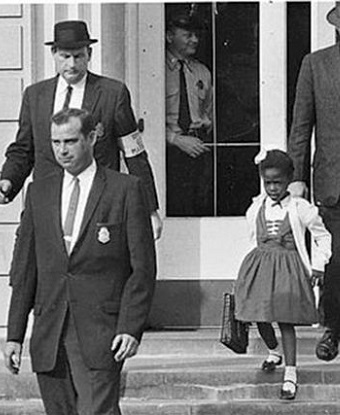
Ruby being escorted by marshalls out of school

Segregation, in the minds of many Americans today, is quarantined to apartheid South Africa or Jim Crow Mississippi. We do not think of segregation as the distance between Smithtown Central School District which is 89% White and Central Islip Union Free School District that is less than 10 miles away and is 92% Black and Hispanic.  We may pass our eyes over this stark difference without understanding why it matters. Lily-White schools with abundant resources in this diverse region means that somewhere else on the Island (usually not too far away) there is a warped photonegative: a majority Black and Brown school contending with concentrated poverty and lesser resources.

Long Island’s diversity is steadily increasing. Families from all parts of the world now claim Long Island as home. Since the 1980s, all net population gains have come from immigrants.  Today a third of Long Islanders are people of color and in less than fifteen years, persons identified as white will be just one of the many groups in the region’s demographic profile: they will no longer be the racial majority.  And yet, more than two-thirds (67%) of Long Island children attend segregated public schools. Most White children on Long Island learn in majority White classrooms and most Black or Latino children attend schools with mostly other Black and Hispanic children.  Only 21% of Long Island students have the opportunity to learn in integrated schools where the student body represents the region —and these numbers are dropping.  Long Island is a cautionary tale for the rest of the country: demographic shifts do not automatically translate into democratic opportunity.

I am the parent of a future Long Island kindergartener. I am also a Black woman and a professor at Stony Brook University. In the past year my family has collided headfirst with this region’s history of segregation. In these parts, school integration is a fantasy; the boundary lines of public school districts enshrine the apartheid principle of separate and unequal.  For example, in the academically successful elementary school about one mile from my office, only 4 of the 623 students are identified as Black or African American; only 8% of the families qualify for reduced or free lunch. Less than 15 miles away, in the Brentwood School district, a full 80% of the students qualify for free/reduced lunch and the vast majority are Hispanic.

What would it take for our family to bypass these patterns of exclusion and separation? How could we support our child’s healthy emotional development and live our values around public education?  We decided to look beyond our highly-praised local public school.  After all, high test scores are not a proxy for teacher dedication or children’s potential. About twenty miles away we found a public school with great principal, dedicated teachers, and an exciting dual language immersion program. Here, our son would have an opportunity that is increasingly rare in Long Island: to learn alongside children of different racial and economic backgrounds. However, we quickly met with roadblocks in our attempts to use economic and racial integration as a metric of school excellence.

In a place where segregated public school districts are the norm, disrupting this pattern is more difficult than you might imagine. We could not give up our place in the local school district and enroll in another public school district without paying significant fees (approximately $15,000/year) in addition to regular property taxes. Moreover, enrolling out of district would require the express approval of the school board of our preferred district. If I could somehow afford these fees and win over the school board, neither district was required to provide transportation. In our case, the integrated school district did not have a clear process to approve out of district applicants, the out of district fees were high, and with full-time jobs and no busing we could not ensure our son safe passage to school every day.  I discovered that there are no mechanisms supporting Long Island families—apart from moving to one of the few diverse school districts (there are 18 out of 125 total)— to choose a non-segregated public education.

In these parts, property taxes are king; their edict is unquestionable and undisputed. Well-resourced families feel they have “bought” or “earned” excellent schools without blanching at the Darwinian logic that apportions out quality education to five year olds based on their parent’s economic location, which in turn is more often than not determined by their grandparents’ prosperity. Our comfort with economic exclusion has bred public schools that preserve and multiply historical inequality;  our educational institutions function as walls between kids from poorer families and kids from wealthier families.

Over fifty years ago when Rev. Dr.  Martin Luther King, Jr. spoke of his much-lauded dream, he envisioned an integrated childhood as a vehicle for national racial redemption. “One day right there in [the] Alabama [of] vicious racists” Dr. King prophesied, “little black boys and black girls will be able to join hands with little white boys and white girls as sisters and brothers.” However, half a century later, although US civil rights law established school integration as a federal and cultural goal, many Americans today neither know what an integrated school is or understand why it is valuable. Many of us would not even recognize an integrated school if we saw it.

In the past six months, I have found that many in my community are confused or indignant when I lament our wealthy and segregated schools. After all, their child has one Black friend or two Asian friends! After all, that child seems very happy in the school! After all, my family is living in the neighborhood! How dare I suggest that our schools are segregated?

(Alvin Chang’s discussion on the data debate around school re-segregation is particularly useful.)

Content to believe that segregation is a matter of a formation of letters above a water fountain, we grasp at the presence of one Black children in a kindergarten class of 50 as sufficient evidence that we, too, are living into Dr. King’s dream. Moreover, we misunderstand integration as a matter of social enrichment when it is primarily a vehicle for equality of access and opportunity.

Yes, research shows that all students benefit socially from integrated classrooms. And of course, school is a uniquely appropriate setting to provide students with the emotional and intellectual tools to navigate a diverse and complex world. However integrated schools do more than grow compassionate and tolerant human beings: they are necessary if this country hopes to pivot toward a functioning democracy. For poor children of all backgrounds, attending a strong, well-resourced public school—which usually is an integrated school— is the single clearest path to a future of opportunity.

There has never been a moment in the history of this country, education journalist Nikole Hannah-Jones explains, where Black people who are isolated from White people have gotten the same resources. The presence of White children has, in the past and present, been correlated with the consolidation of economic and cultural resources needed for strong public education. This is not because families of color care less about education. On the contrary, in a country where racial identity has been a proxy for citizenship, persons marked as White have historically had greater access to wealth and resources because they have enjoyed full citizenship rights.  Fighting for school integration today is a way to ensure that the cultural and economic resources that have accompanied full citizenship are not hoarded within white communities.

When Melba Moore Beals and her eight compatriots put themselves on the front lines at Little Rock’s Central High, they fought to establish the right to an equal education regardless of identity. Today, we praise the Little Rock Nine and just the same, continue to send scores of brilliant American children to separate and unequal schools. We do violence to the courage of little Ruby Bridges in her starched pinafore by insisting that segregation is over because a few wealthy families of color can avoid under-resourced schools.

In diverse Long Island, our segregated schools are not an inevitability but a choice. However, it is folly to think that individual families can “choose” integration or fight the battle for equality  on their own. Erase Racism, a local think-tank, suggests that one solution to Long Island’s school segregation problem is to redraw school districts along town and city lines. Instead of 125 tiny, separate, and unequal school districts, there would be 15 districts, none of which would have an overwhelming number of poor students and all of which would represent the demographic range of the island as a whole. Anti-racist parents and teachers across the region must come together and wrestle with ideas about how to ensure that quality education and integration for all our children is on the agenda.

In the meantime, in Suffolk County where I live, there are a handful of integrated school districts. These districts should be visited, championed, and supported by all parents and educators who are committed to racial justice.   Albany should ensure that integrated districts that are taking on the challenge and privilege of teaching all students and modeling a truly public education are well-resourced and thriving. Families like mine who live in well-resourced and segregated districts must begin to ask the hard questions: Why, in 2018, in a diverse Long Island, are our children attending schools that are overwhelmingly segregated and unequal? What are the consequences of raising children in segregated schools and then expecting them to function as good citizens? How can we extend the fierce love we have for our own families outward?