On this eve of Juneteenth I’m sharing the video of my remarks at a Stony Brook University town hall about systemic racism. The text follows:
My name is Abena Asare and I’m Associate Professor of Africana Studies and History in the Dept. of Africana Studies.
We meet today in the midst of an uprising against state-sanctioned violence targeting Black and African American people in the United States. This uprising is focusing on transforming systems of racial violence and the individuals and institutions that defend, benefit from, and justify these systems. This is an uprising watered by the blood of Black folk, Black trans people, men women and children who have been lynched at the hands of the state. We sit in the shadow of families and community members who have HAD to organize, and march, and protest and give public statements, in the midst of their mourning.
So we say their names! Rayshard Brooks, Maurice Gordon, Tony McDade, Elijah McCain, Sandra Bland, Philandro Castile, Breonna Taylor, Eric Garner, Mike Brown, Korryn Gaines. We say their names to make the state’s violence visible. We also say their names because each of these losses ruptured a whole world; these were unique, inividual human beings who were relatives, mothers, friends, loved ones. Each is irreplaceable. These are not hashtags or bodies, each of these precious ones was someone’s whole world.
Even as we say their names we realize that we cannot finish; the list is just too long. Those cut down explicitly and covertly by our state keep coming even as we weep, and get our degrees, hold our zoom meetings, and raise our children in fear and hope. This problem of state lynching which is a manifestation of society’s investment in morbid anti-blackness is not a matter of a few bad apples on the police force, or a particularly sympathetic victim, a particularly brutal death; we are speaking today about the routine, deadly violence that has kept the wheels of this country’s economic and political system churning as it has for the past 400+ years. What does it mean to say a enough! Enough already.
We begin by taking stock of where we are. I need to acknowledge the decades of organizing and labor that have led to this current moment. We need to know that the Black Lives Matter movement, founded by 3 Queer Black Women n 2013 is a reclaiming and reignition of the Black Freedom Movement that extends back to the 1970s to the Black Panther Party, to SNCC, the Student Nonviolent Coordinating Committee in 1960, to Ida B Wells and her campaign against lynching in the 1920s, to Frederick Douglass who asked in the 1850s what to the slave is the 4th of July, a question that fundamentally is not about where Black people fit into the nation, but really about where the United States fits into the annals of global inhumanity.
So where are we? In the past three weeks, the Minneapolis City Council voted to disband the city’s police dept and instead fund public safety system.
The University of Minnesota has also severed all ties with the police department.
Increasingly, folks around this nation are willing to acknowledge that pouring money into police state, does not make us safer, but that it does make the country more unequal and definitely more deadly for Black and Brown, poor, and disabled folk. More people around the country are beginning to step towards a realistic vision of public safety.
This past Saturday, 15,000 ppl marched through Brooklyn to protest this state’s violence against Black trans women who face disproportionate levels of harm both at the hands of police in the streets.
Racist statues are tumbling into the sea, pulled by the hands of people who believe that we need other iconography, others images for our public spaces.
At the same time, over these past week, we have seen police assaulting protestors in our urban areas. We are living through a time where police are pepper spraying crowds of protestors in the midst of a deadly virus that specifically attacks the human respiratory systems. This should be considered a crime of war and must be stopped immediately.
What I’m saying is that this fight is far from over; this is not the time for platitudes and complacency. Not at all. This is a moment when each of us, individually and corporately are being invited to take a look at our power, where did we get it from, what is the nature of the power that we hold, and what do we want to do with it.
Which brings me to Stony Brook and to this meeting today. We should be clear about on thing. Many of the institutions that have been quick or slow to release statements declaring their support for Black LiVes have yet to do anything at all to address the systemic racism that plagues their institution. And no a panel, or a town hall does not count as something.
It may be convenient to wring our hands about about George Floyd, but we must acknowledge that there is a man called Akbar Rodgers, a Freeport, LI man, not too far from here, last December 2019, who was beaten and assaulted within an inch of his by the police in Suffolk County. We have to acknowledge Jeffrey McClure a 26 year old man who was shot and killed by the police in Northport just a few days when his father called 911 for psychiatric help. In Suffolk County, black and brown people make up just 17% of the population, but account for 53% of felony arrests. In fact, the US Justice Dept is currently reviewing Suffolk’s record of traffic stops and race because the data is so egregious. (I want to thank Nia Adams of the Long Island Progressive Coalition for some of these statistics). So what is Stony Brook University’s relationship to the Suffolk County PD? Stony Brook is the largest emplyer, the economic hub of the region, what does it mean for our institution to lead in saying our budget and our practices should reflect our values?
When university release these Black Lives Matter statements we must ask how these relate to the ongoing “reopening plans” that do not take into account how Black and other communities of color are being affected by the COVID 19 epidemic. My colleagues Joseph Pierce and Odalis Hernandez in the UUP have written an open letter insisting that the question of reopening and how it is done IS a racial justice issue, is an equity issue, and that we must protect the most vulnerable members of our community as we make these plans. I would encourage you…
As we wring our hands about George Floyd we would do well should consider our own university’s links to prison labor. In 2019, Stony Brook University and the hospital spent nearly 40,000 on prison-made goods. Thanks to historians Rob Chase and Yalile Suriel for these numbers. Our institution is tied up in our national nightmare of racial violence. The question is what are we willing to do about it.
So
The cry Black Lives Matter is not only about the police as an isolated institution; the cry Black Lives Matter is looking at systemic racism and the way it is reproduced and protected and furthered by a number of institutions across society. This country, has historically, in law and in practice, valued property and wealth, and the need to defend these, more highly than it has valued the lives of many of us within its borders–specifically Black, Brown, and indigenous folk. In a country located on stolen land, built through stolen labor, the cry Black Lives Matter in 2020 is a call to do the necessary work of imagining and pursuing a future that is not forever trapped within our violent racialized national history.
I am so honored that Truth Without Reconciliation has been named a 2018 Outstanding Academic Title by the American Library Association Choice magazine.
“Every year in the January issue, in print and online, Choice publishes a list of Outstanding Academic Titles that were reviewed during the previous calendar year. This prestigious list reflects the best in scholarly titles reviewed by Choice and brings with it the extraordinary recognition of the academic library community.
The list is quite selective: it contains approximately ten percent of some 6,000 works reviewed in Choice each year. Choice editors base their selections on the reviewer’s evaluation of the work, the editor’s knowledge of the field, and the reviewer’s record.
In awarding Outstanding Academic Titles, the editors apply several criteria to reviewed titles:
overall excellence in presentation and scholarship
importance relative to other literature in the field
distinction as a first treatment of a given subject in book or electronic form
originality or uniqueness of treatment
value to undergraduate students
importance in building undergraduate library collections
The Choice Reviews feature on Truth Without Reconciliation is found in the December 2018 issue.
“This fascinating work explores the thousands of testimonies collected by the truth and reconciliation commission (TRC) in Ghana in 2003 and 2004. Asare (Africana studies, Stony Brook Univ.) critiques the limitations of the reconciliation framework that gained popularity after the South African TRC of the 1990s. Rather than simply deflate the pretensions of individual testimony and national healing, however, this study takes on the challenging task of constructing narratives from the widely divergent collection of statements by victims of political violence since Ghanaian independence in 1957. This allows Asare to explore how ordinary Ghanaians, soldiers, and civil servants negotiated with political authorities. Ghanaians appropriated human rights rhetoric not to support a general notion of national unity. Instead, they raised a wide range of individual concerns about matters ranging from the ways soldiers targeted female traders as traitors to the nation to the ambiguous position of the military itself, since many soldiers became victims of military regimes. Deftly drawing from a broad range of critical theoretical approaches, Asare’s study is a model for its methodology and organization. Truth without Reconciliation should be required reading for anyone interested in national reconciliation programs.
–J. M. Rich, Marywood University
Summing Up: Essential. Upper-division undergraduates through faculty; general readers.”
Thank you for this invitation to share in International Stuttering/ Stammering Awareness week. A special shout out to Sakina and the other organizers for all that they did to make this happen, and all they are doing to build up this inspiring organization.
Thanks also to Courtney Luckman, for her sharing today and also for her research. It blows my mind that these days, when a child or young person, on some late night, with tears in their eyes, is searching desperately on the internet for some sort of help, some answers about their speech — how lucky we are that they might find Courtney and her articles, or her lab, all of these amazing stammering speech language pathologists and researchers, who are adding so much information into the public sphere and into the culture. We all benefit from that, so thank you.
How lucky I am to meet you. As a child I could not imagine a space like this one– the Ghana Stammering Association. I could not have imagined this space, but I desperately longed for it. You see, I was raised in the diaspora. My parents, siblings and I left Ghana, Cape Coast, in the early 1980s in a time of coups, food crisis, and soldier rule. We left “for a few years” knowing that we could come back, and those few years, for me, have stretched into forty and counting. So I was raised in the United States with this sense of roots transportation, with the sense of alienation, a sense of being in a place that was not my own, and where I was seen as less than within this system. We were the only African family in our small, white town in Massachusetts which meant that there was already a gulf of misunderstanding, of ignorance, surrounding us. “Did we live in trees back in Africa? Did we wear clothes or shoes? Weren’t we escaping starvation, or civil war? Weren’t we so grateful to be here?” And then on top of that I stammered. This, surely, did not help my case. After all, these people already saw me as less-than, already teased and scoffed at my dark skin, already were surprised that I spoke English at all. And then when I open my mouth to speak, I stammer?! Oof! Partially I blamed myself? Why couldn’t I be like my other siblings? Why couldn’t I speak easily? Maybe I would have been more able to fit in, if I did not have this struggle.
BREATHE
I have written a small poem for that small Abena because finding the transnational Ghana Stammering Association for her would have been like finding a lifeboat in a storm.
The ocean between us
slips from my lips and springs from your eyes.
“Mmmy N-n-name is Abena Asare”
In the twists and tricks and trills of my tongue and lips,
Shame and shock trickle then gush, pity sweeps me from my feet.
The water rise, push us to opposite shores
my heart is a speck, bobbing in the distance.
These waters are opaque, unfathomed,
teeming with all that has been,
all that never was,
all that is left unsaid.
So as a child, I decided that If I could not overcome my stammering, perhaps I could drown out this shame with a flood of other achievements. I would try to always come first in the class, I would be the best at sports, I would write the longest and most creative essay. I would shine above and beyond in the hopes that my worth would never be questioned. If I could not overcome my stammering, I would excel myself out of the cycle of shame. I would do all the public speaking and find a way to get it right! I could practice something perfectly fifty times, and then the event would come, and suddenly, up on the stage, sometimes my stammer would appear. This was the elephant in the room, or rather I should say the elephant in my head. And I never talked about it with anyone– if I did not call attention to it, maybe one day, poof, would just disappear. But what happens when that elephant in the room is never acknowledged? It becomes your own private elephant to carry.
Carrying it was exhausting. I tried everything. Prayer, different tricks and tools. I would practice the text, I would tap my fingers, I would switch/ change around/ alter/shift words. I would work on my breathing, my elongation, I would imagine the audience naked, I would calm my nerves, I would do anything and everything to “overcome” my stammer. Sometimes these techniques and practices would work. I would have moments, months, years, of public fluency and control. In high school I was a national speech team champion. In my youth, I won numerous awards for my public speaking, and I did this all without mentioning my stammering, just would hide it, control it, by force.
It. Was. Exhausting.
Maintaining the facade of fluency was like another course, a full-time job or maybe even another Ph.D. Moreover, there was a rind of anxiety that was always there. In a fluent moment, I was anxious about when the stammer would emerge and everything would change. If I was stammering, I was awash in shame and disappointment. What about all of my hard work? So I was excelling, and I was tired, and I was lonely, carrying this elephant on my back.
This exhaustion led me to seek help for my speech when I finished my first degree, and was finally entering my adult era. Finally, I thought, I would seek out and find the speech therapist etc. that would be able to help me “fix this” once and for all.
So, spoiler alert, I did not find that fix, but I did find the stuttering self-help community. In circles just like this one, (BREATHE) I learned and am still learning, to set down my isolation and loneliness. In circles like ours, I learned how to be with myself and my stammer, by being with other people who stammer. It was that simple: as I spent time with us I began to love us. I began to hear the beauty in our voices. It became clear to me that stammerers had as much, maybe more to say, of value than fluent speakers. I began to experience the magic that happens when we stop devaluing, censoring, or stigmatizing our voices. We may stammer less, we may stammer more, but we are able to speak joyfully and to share whatever is in our hearts.
Maybe you have heard the term ableism? Ableism is defined as: discrimination, social prejudice, or systemic bias against people with disabilities. This was a term created by the disability rights/ disability justice movement of the 20th century. They named ableism in order to identify the attitudes and structures that had to change to make a world where people with disabilities, all types of disabilities, are included and able to reach their full potential. Now, internalized ableism is when we ourselves are prejudiced, biased, and censoring of ourselves, because we have accepted the story, whether consciously and subconsciously, that we are less than as long as we stammer.
Only by being together with other people did I begin to feel that it was ok to stutter. My radical self- acceptance happened because of you. It did not come from greater fluency, or from reading studies about stuttering, or from consuming positive literature, or progressive theory, or prayer, it was sparked by spending time in stammering circles. When I hear your story, I am even more passionate about creating a society where you can thrive. When I know what you have gone through, my understanding of ableism as an injustice grows, and I begin to struggle against it.
Look, we are in times when there is a desperate need for truth-tellers, for deep thinkers, for people who have empathy and can listen well, there is a desperate need for our voices, our voices that AI can not imitate (at least not yet)! In this time of thousand pound bombs and genocide, where it seems that human life is being made to be cheap, if we make space for our own true voices and we clear space for all our fleshly authentic humanity, to rise up again and again from the ground. This is the power that we have in our stammering voices.
So I am a person who stammers.
Mmmy nnname is Aaabena Asare.
The space between A and Be is fertile.
There, time can never be money.
The clock spins backwards,
an anthill grows into a mountain and shrinks back again.
My purpose falls from my lips
The trembling of my tongue is the shaking
of a heart as it grows,
the waving of a tree in the storm.
Watch me bow and not break,
watch me tumble to the end of this word,
(Acrobatics!) And know victory, find grace,
freedom’s volume in one single breath.
What would happen if we stammered freely, stammered proudly, in a world like our own, what would change? Well, when I was a kid, I never knew anyone who stammered. I definitely never saw anyone who was stammering loud and pppproud. I did not even know that was possible. What would it have felt like to attend a meeting of the Ghana Stammering Association as a kid? What if I didn’t have to carry the elephant alone? When we are our authentic selves, just by embracing who we are, we can change the horizon drastically for the next generation. We have the opportunity to raise up a generation of youth who know that they can shine, and walk through any door, with pride and wholeness, even as they stammer. This transformed future is in our hands– or rather in our voices, and how we share them.
(This verse is dedicated to my student ——- the head of the campus-based student disability justice organization, who, in her youth, and her wisdom, and her need, asked me a question that I had never ever been asked before in my life: Professor Asare: why don’t you stutter more?)
For so many years, I saw my stammering as an obstacle to my purpose and mission in life. It was the ocean that kept me away from people, locked in isolation, it was the reason that I was misunderstood, that I had to work harder than everyone else, that or exhausted. It was the thorn in my side, always lurking. Now, I have come to feel in my body that my stammer is not an obstacle to my work, it is the pathway to my work. It is the thing that consistently keeps me authentic, keeps me creative, it is the thing that draws me closer to you. Thank you for inviting me to share some of my story, I cannot wait to hear yours.
My president is John Dramani Mahama. For the first time in my adult life, I claim a sitting head of state as my president. No president in perfect, and Ghanaian politics is no paradise. Still, Mahama is trying to do something with the office besides dine and dance, laugh and leave. President Mahama is not an electrifying speaker nor a particularly charismatic presence, but what oozes from his pores when he takes the stage is in much shorter supply today. There is no shortage of brainpower in the world, especially in Ghana. Courage, however, for those crowned with power, appears frighteningly scarce. There is a question echoing in our painful global silences: what is your intelligence (your wealth, resources, accolades, opportunities) for? Who does it serve? President Mahama, standing on the UN stage, says something about Ghana and Ghanaians, something about Africa and Africans, something about Palestine and Palestinians, Cuba and Cubans, and so forth; he speaks of a teeming world that will live, and not as collateral damage for an imploding/ exploding behemoth throwing out fire and flame as it twists itself into dust.
If you do not want to be caught looping the rope over the thickest branch of the tree or flaying the soles of feet with cowskin or thorns;
If you care about your brother or sister caught in the crosshairs, consider that the algorithm is a multiplier of violence.
Even your circumspect, righteous, or brief reflection is snatched into the larger hole.
So. Please. Do not post, publish, or pontificate into the algorithm’s void about the mess they regularly bring to someone’s door.
Remember that each missive builds into a tsunami wave that eventually crashes down over a single neck. The algorithm lives. It also kills. It turns the raving of a single garden-variety racist into a licking fire, and who holds the kerosene can? It is time to wise up about the machine-worlds we inhabit and what they do.
Jump the fence.
Game the system.
Burrow underneath these platforms, the wet dreams of billionaires and reach for someone’s flesh and blood hand, or eye; touch their elbow.
If you want to “widen the conversation,” would you consider writing directly to a brother or sister standing in shifting sand? Send him your poem, your thinkpiece, your smart and snappy reaction to the facts of our life under these flags.
If you cannot reach her, send it to another sibling-warrior-comrade-friend-colleague-enemy who will argue with you, laugh with you, hold you or cry with you. Who was it who told us to say something real to someone real?
If we care to, we can do this.
Absent ourselves from the feeding frenzy, slip past the hounds braying for blood,
“The Spirit of the Lord God is upon me, because the Lord has anointed me to bring good tidings to the poor; he has sent me to heal the brokenhearted, to proclaim liberty to the captives, and the opening of the prison to those who are bound…” Isaiah 61:1
In Ghana, the Church of Pentecost has built a prison facility. Ejura Camp Prison–the first ecclesiastically-constructed carceral institution in Ghana–has rained down criticism on the Church of Pentecost. Can this be a right choice for an institution dedicated to righteousness?
In Ghana, the road to carceral expansion is being hewn through the language of human rights, modernity, and public-private partnership. In a context where the existing prison buildings and conditions are so poor, there are those who pursue the rights of incarcerated persons by calling for bigger prisons, newer prisons, cleaner prisons, more prisons! And then there is the global security sector, waiting in the wings, eager to build cages and profit. What is the defense against carceral expansion made in the timbre of human rights?
Imagine that you live in a Town of half a million people, bigger than many US cities, on a thin little island/peninsula in the Atlantic Ocean.
Imagine that this Town’s waste plan for the past 50 years has been landfilling garbage, and then burning the garbage and landfilling the ash.
Imagine that this Town’s landfill has a 50 year history of mismanagement and blight including leachate plumes federal and state air quality emissions violations, noxious smells, and public health concerns.
Imagine that the community living closest to the Landfill is a Black, Latinx, Indigenous working class community, with a high population of children, many under the age of 5.
Imagine that this particular community adjacent to the Landfill has the lowest life expectancy of all of Long Island.
Imagine that you are living in the midst of climate crisis.
Imagine that incineration, burning waste is toxic and polluting.
Imagine that new incinerators and ashfills are almost impossible to build in this country, in this day and age, so those that exist, usually placed decades ago next to communities of color and/or poor communities—are expanded and refitted as the last gasps of a dying industry.
Imagine that in 2017 a documentary was made about the adverse health outcomes of the students and staff at a public school near the Landfilll.
Imagine that in the midst of the anguish and fear of parents, teachers and community, Town officials promised that the Landfill would close down when it reaches the end of its life in 2024.
Imagine that the Town officials do very little to plan for the closure of the Landfill, and instead apply for and win a state grant not to close the landfill but to expand it by building a new ashfill next door to it.
Imagine the community’s mistrust, the frustration, the uncertainty.
Then!
Imagine that the community says enough is enough and #ClosedMeansClosed!
Imagine that we say we will no longer accept the Town’s mismanagement and lack of planning! That we say human life is worth more than tipping fees. That in 2020 we can do more than burn increasingly large amounts of garbage and fill up holes in the ground until they become mountains, and then dig new holes next to the old toxic ground until the land spits us out.
Rise up Brookhaven, it’s time. Enough is enough! #Closed Means Closed
This was a FB post I wrote in October before one of our Landfill protests. Hopefully if we have time in the Q&A afterwards, I can share the rest of the story of where the fight to close and clean up the Brookhaven Landfill is right now)
II.
Thank you for inviting me back here today. I am cognizant that there is a certain cyclical aspect to my return to the Unitarian Universalist Fellowship of Stony Brook pulpit. I am grateful for your desire to remain in community with me as the years pass, thankful to have this space to come, listen, and share, again. In the past. you invited me to talk about the Black Lives Matter concept and what it meant in Eastern Long Island. Today you have asked me here to talk about Earth Day and to share a little bit about my work as part of the Brookhaven Landfill Action & Remediation Group or BLARG.
Before we march toward Earth Day and talk about BLARG, I have to first return to one of our earlier meetings, in the year 2016, when I came to this pulpit to speak, I believe for the first time.
Now, I know that a lot of water has passed under the bridge in the years between then and now. Not everyone who was here then is here now; there have been shifts and losses. I want to acknowledge all that has happened since we last met. We have lived through the Trump presidency, we are living through the Covid 19 pandemic, I am joining you on video. There is a lot that has changed.
When I was last here, the fellowship was in the midst of some heavy discussion about a Black Lives Matter sign that kept on being stolen, a Black Lives Matter sign that made some of Felowship’s tenants and members concerned and fearful, a Black Lives Matter sign that spurred a intense discussion about who you were in this community and what that meant. In 2016, after I spoke, some in this community raised concerns that these three words strung together : Black Lives Matter were divisive or unnecessarily exclusive. These words Black Lives Matter, some worried, sought to prioritize a particular population, to lift up a small slice of the human community above others.
These concerns are not unique to this fellowship, obviously. The retort, ALL LIVES MATTER is a crystallization of the fear, this suspicion that Black Lives Matter somehow stands in opposition to recognizing the humanity of all of us. So when we spoke in 2016, I tried my best to explain the vision of interlocked and interdependent freedom buoying up these words: Black Lives Matter.
I should have referenced the Combahee River Collective, a Black, feminist socialist organization in the 1970s, who theorized it clearly when they explained that “If Black women were free, it would mean that everyone else would have to be free since our freedom would necessitate the destruction of all the systems of oppression.” The Black Lives Matter Guiding Principles, which are geared toward explaining the BLM concept to children explan this vision of interlocking freedom in this way: “To love & desire justice for ourselves is a necessary prerequisite for wanting the same for others.” Perhaps the simplest articulation of this idea that I’ve heard is a chant that you often hear at protests: All Lives Will Matter When Black Lives Matter.
Now, the difficult thing about accepting that a vision of interlocking and interdependent freedom requires setting some priorities, is that this flies in the face of everything we have been taught about how power works within our national history. What happens to my freedom, the All Lives Matter crowd wonders, when I fight and center the rights of some other community. The concept of a shared, interlocked liberation seems unbelievable in a country like ours, founded on settler colonialism, forged through the transatlantic slave trade and built up on a diet of war and wealth pursuit. In a country like our, power is always mapped onto domination. And so there are those these words some insist that BLM is a trick, a way for Black folk to grab resources and power. And those with more liberal sensibilities immediately start to wring their hands, wondering whether the framing may be too divisive and lack traction.
Even though our political heritage in the United States tells us that freedom is something to be hoarded, and that our power comes from our ability to dominate resources; the earth that groans under the weight of our choices and our apathy, tells us another story.
What is our responsibility in this season of floods and droughts, of wildfires, of pandemics? The earth is teaching us a lesson about where we are and when we are; we are being taught new priorities. As we confront a climate crisis that will not be denied, our inherited understanding of progress and power must be shifted. Part of what BLARG has taught me is that, given the time it is on the clock of the earth, there is no greater priority than community.
That is my topic for today, strategic community in the time of the climate crisis.
III.
I am a member of the Brookhaven Landfill Action & Remediation Group or BLARG, a community coalition that has come together since the summer of 2020, in the aftermath of the George Floyd murder and the summer of uprising to support the closure and the clean-up of the Brookhaven Landfill.
In the summer of 2020, advocates and activists from North Bellport came together to insist that Black Lives Matter must have local agenda. These activists came together to insist that in Suffolk County, we could not say Black Lives Matter without also saying something about the Brookhaven Landfill.
The Brookhaven Landfill is a grave environmental injustice hiding in plain sight. In 1974, the Landfill was placed next to one of only two majority Black neighorhoods in Brookhaven Town. Since then, the Landfill has been a particular blight on the working class community of North Bellport and has expanded and grown over the years. Now it is a regional waste destination, and the mountain of waste has grown to 276 feet. There are fifty years of toxic odors, fifty years of complaints from the fenceline communities. The properties of North Bellport have been impacted by their proximity to the Brookhaven Landfill, the public school district has been impacted. The Landfill has been a troubled and mismanaged site for decades, has been fined hundreds of thousands of dollars by the US EPA for violating the Clean Air Act. Something is terribly wrong. And even as I also want to acknowledge the beuty and resilience of North Bellport . There is so much innovation, so much talent, so much heart and history and pride and genius in this community, and the Landfill is a limiting factor that limits the construction of affordable housing, a destabilizing factor as teachers leave the district in order to not teach at the base of the Landfill, it takes people away too soon.
For all these reasons, at BLARG we center and prioritize the experience of North Bellport, the fence-line community that has borne the brunt of our region’s waste needs for the past five decades. For this community, the Landfill is a toxic neighbor; the families who breathe in the noxious smells, whose mental and emotional health is impacted; whose ability to gain equity and wealth in their homes is impacted must have a voice, and a seat at the table.
But we should also be clear about one thing: the Brookhaven Landfill is not solely a North Bellport problem. Today, the Brookhaven Landfill accepts the waste of 2 million people, approximately 660 K housheholds. Every year, around 700 K tons of construction and demolition debris and 350 K tons of incinerator ash is deposited into the Brookhaven Landfill. As a lynchpin in the Long Island’s regional waste infrastructure, we have to understand that all of us in this room are connected to the Brookhaven Landfill. In this highly segregated Long Island, the Landfill is one thing that we all have in common. Our Brookhaven Town elected official in both political parties have embraced the Landfill as a cash cow, they have shielded it from scrutiny because its net revenues account for a certain percentage of the Town’s operating budget, and so, for decades, the complaints of the proximate communities have been brushed under the rug. The Brookhaven Landfill is part of our collective story, and as we often say at BLARG, it will take all of us to close the Landfill and get it cleaned up.
When the Brookhaven Landfill completely closes, it will be because we have gathered together as a community to push our local and state government to develop a rational, regional and sustainable plan for waste management. When the Brookhaven Landfill is finally cleaned up, it will be because we gathered together as a community again, and pushed our government to acknowledge the harm of the past decades and to prioritize economic, environmental, and social redress for the communities that have been impacted. The existence of the Brookhaven Landfill, which allows the Town to profit from the cycle of burn and dump has protected Covanta Energy, the multinational incinerator company operating on Long Island from scrutiny. Covanta as one the biggest polluters, one of the largest sources of emissions in NY state, and when the Landfill finally closes it will be because we care about leaving a habitable world for our grandchildren. The closure of the Landfill is also an impetus to develop and commit to a zero waste plan with clear and measurable targets for reducing and recycling our waste. Our abysmal recycling rates will be a thing of the past, because we will have had to roll up our sleeves and create a plan to actually be accountable for our waste. When the Brookhaven Landfill finally closes it will be because we have come to terms with where we are, and when we are, and have decided to be accountable for our impact on the Earth.
BLARG’s fight for justice for North Bellport is also a fight for a liveable future for us all and an ethical relationship with our neighbors, near and far, and our earth.
IV.
I would like to share a short video clip at this time of comments made by Supervisor Romaine at last week’s Long Island Metro Business Association breakfast meeting. After speaking about the solid waste crisis, the Town supervisor opened himself up for question and answer period. I asked a question about why environmental justice concerns were not a part of the supervisor’s presentation and specifically why the experience of North Bellport residence and other proximate areas was not a part of the Supervisor’s presentation. This was the Supervisor’s response: “Abena, for example, does not live in North Bellport. She lives in Brookhaven Hamlet, one of the wealthiest communities, that we have in Long Island. So for her to speak for North Bellport is somewhat disingenuous.”
North Bellport speaks for itself. North Bellport has been speaking for itself for fifty years or more about the Brookhaven Landfill. When neighbors join their voices with North Bellport to advocate for a better future, it is the opposite of disingenuous! It is strategic community!
Without attempting to single the Supervisor out, I share these clips because it is rare to have such a clear distillation of how an impoverished sense of community has been weaponized to insulate the Brookhaven Landfill from criticism and to circumvent accountability.
For Supervisor Romaine, my home’s location in Brookhaven hamlet somehow invalidates my concerns about my neighbors in North Bellport. Our Supervisor drops my address in Brookhaven Hamlet as though the location of my home somehow makes it impossible for me to care about conditions that are past the end of the road. Perhaps the Supervisor does not know that before I was a resident of Brookhaven Hamlet, I was a Black woman in America, and that for me, injustice wherever it is found, is definitely always my business. Perhaps the Supervisor does not know that long before I was a resident of Brookhaven Hamlet I was a follower of a Middle Eastern teacher and mystic who posed the question, ‘who is my neighbor?’ as a life ethic and policy program. Perhaps the Supervisor does not know that before I was a resident of Brookhaven Hamlet I was a resident of planet earth.
One of my civil rights heroes Grace Lee Boggs, a Detroit civil rights activist and revolutionary thinker, it is said, always used to ask comrades, friends, and advocates doing liberation and movement work the question: what time is it on the clock of the world? Grace Lee Boggs posed this seed of a question as a way to challenge justice-minded people to consider whether their strategy and choices were actually aligned with where and when we actually are in historical time.
In some ways, this is the same question that the climate crisis youth activists are shouting from the rooftops. How must we organize, live, and travel, and feed ourselves, considering the clock of our world?
When I consider the clock of the world, there is nothing more important than strategic community. So this is the question that I will leave you with today? What time is it, UUFSB, on the clock of the world?
You said this at a town board public hearing where we spoke FOR a sustainable and equitable waste future for Long Island and AGAINST the Town’s ongoing strategy of investing in non-sustainable, non-transparent, and poorly thought-out waste “solutions” that just pass Long Island’s waste problem onto someone else. For the past fifty years, the community of North Bellport, which sits adjacent to the high-volume Brookhaven Landfill, has been that someone else.
These were our main points:
1. The proposed Gershow/Peconic waste transfer station in Medford furthers environmental injustice. One of the proposed end destinations for the waste is Sunny Farm Landfill in Fostoria, OH, a troubled and mismanaged site with dozens of violations and citations, and millions in settlements. The small rural community of Fostoria is fighting for their lives and their children’s lives in the midst of an onslaught of waste from all over the country.
2. Allowing special permits and waivers for a waste transfer station to rail out up to 600,000 tons/annually of construction and demolition (C&D) waste is unsustainable. Brookhaven Town needs to FIRST develop an equitable waste plan with measurable benchmarks and strategies to reduce, reuse, and recycle C&D waste and divert it from landfills. Then, with that plan in place, we can talk about new waste infrastructure. As you know, Brookhaven Town does not currently have a New York State- approved solid waste management plan. After submitting a plan that received substantial critical comments from the Department of Environmental Conservation (DEC) three years ago, the Town’s plan has still not been revised or approved.
We at BLARG reached out to our neighbors in Fostoria, OH to tell them that hundreds of thousands of tons of our Long Island waste would be coming their way if the Gershow/Peconic plan was approved. Dismayed, they wanted to make their voices heard. The community sent a moving letter and Dr. Katy Johnston read it at the public hearing.
It was after Dr. Johnston shared this letter that you told us that we were both in the wrong pew and in the wrong church, meaning that the plight of our Rust Belt neighbors, however terrible, was not your problem, nor that of the Brookhaven Town Board. You evaded responsibility, Supervisor Romaine, even as you sought to approve a plan to dump up to 600,000 tons of waste on their heads.
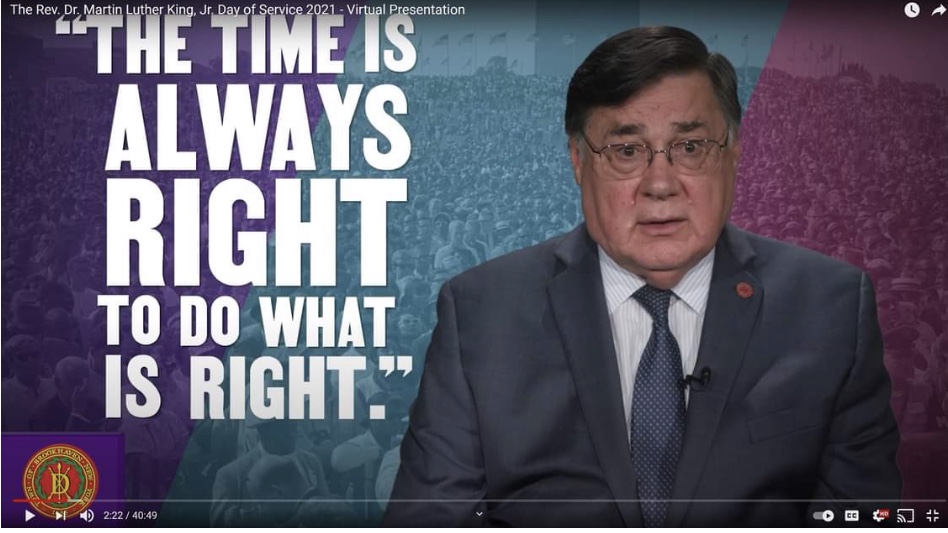
A few weeks before this public hearing (remember: wrong pew, wrong church) you presided over the Town of Brookhaven’s Martin Luther King Jr. luncheon, where you highlighted one of Dr. King’s most well-known quotations: “the time is always right to do what is right.”
We have the misfortune of living in a time when all and sundry parrot Martin Luther King, Jr. in the first two months of the year, and ignore MLK’s message for the other 10 months. This is the way of things. Our hero Martin has been consumed by the U.S. media machine and is spat back out to us and our children as a mangled facsimile of himself, for shame. But still, in this Black History Month I will call out the contradictions in order to fight for Dr. King, this brilliant person gone too soon, and his legacy of words and deeds.
When Martin Luther King Jr. said, “the time is always right to do what it right,” he was not speaking at an MLK Jr. Day Luncheon. The year was 1964; three civil rights leaders had been murdered in Mississippi, six U.S. cities had erupted into riots, and the future seemed to hang on tenterhooks. Dr. King described what was required of each of us. “If we are to go the additional distance to make justice a reality…. we are going to have to do something about it.”
The words you uttered come with a context. They are heavy; laden with the frustration of the man who wrote from Birmingham Jail a year earlier about the white moderate more devoted to “order” than to justice. These words admonish those who rely on bureaucracy and fear to justify their inaction. In short, Dr. King was speaking directly to you, Ed Romaine, who hears the pleas from a landfill community in Ohio and quips that we have chosen the wrong forum, that we are in the wrong pew and wrong church.
Also, a note about this callous analogy. As a person raised in the Christian church, who remains part of this battered and bruised Christian church despite the ways that love, justice, and holiness are wrung out of the institution by patriarchy, anti-blackness, and homophobia, I take great exception to this idea that it is possible to be in the wrong pew, or the wrong church. If I enter any house of worship crying, “brother, I am dying,” and am told, “no, sister, you have the wrong seat,” or “the church around the corner might be a better place to carry your suffering,” I would posit that I am not *actually* in a church at all.
There will always be people like Town attorney Annette Eaderesto who would try to press us into ignoring the singular power we each hold: the ability to say ‘no’ when it matters. There are those who insist that acting based on ethics and not ease is against the rules; that we lack the “precedent” to evaluate a land use proposal and consider that land and lives outside our own zip code also matter! You and your colleagues at the Brookhaven Town Board are surely not alone in claiming that justice is not in your jurisdiction.
The problem, Supervisor Romaine, is that you cannot quote Martin on a Tuesday and scorn him on a Friday. You should not preside over Black History Month celebrations or call the names of civil rights heroes if you will not listen to their words or ponder their import.
The Brookhaven Town Board has considerable power over Long Island’s waste future because our Landfill is the largest waste depository in downstate New York. When Brookhaven decides to roll up its sleeves and get to work on this matter of waste, the rest of the region and the private sector will have to follow. It is absolutely appropriate for the Town Board to assess whether the Gershow/Peconic proposal fits into the town’s solid waste management plan. Unfortunately, the Town has yet to develop and pass a plan!– let alone one that is sustainable and prioritizes human life, clean water, and clean air!
But none of this is news to you, Supervisor Romaine; you just have not decided that this is the time to do what is right. The only question I ask you now, echoing another civil rights hero, Grace Lee Boggs, is what time is it on the clock of the world?
Sincerely,
Abena Asare
The Brookhaven Town Board is accepting public comments on the Gershow/Peconic Waste Transfer Station Proposal until Thursday 2/25. Background documents for the proposal are found here. Please send comments to pfountaine@brookhavenny.gov
The COVID-19 crisis has reignited a long-standing conversation about mutual aid and its role in our capitalist modernity. Mutual aid: the idea that community’s got to do for ourselves is nothing new, not at all. For those who know the state as the kindred- catcher, the child-snatcher, the doler-of-goods separate and unequal, the dog at our heels, the boss breathing down our neck— for those who call the government the (inhu)Man— taking refuge in the We is nothing new, not at all. However, in these first six months of 2020, as the painfully gaunt social fabric of the wealthiest country in the world has showed itself plain, the surge in mutual aid networks signals a shift: the myth of American exceptionalism has cracked and shattered for many— including some who call themselves white.* The most recent occupant of the White House has snatched away dreams of swift rescue at the hand of a national paterfamilia and so the power of the We has come, somewhat desperately, back into vogue. But what is mutual aid and how does it differ from the neoliberal charity that we have always had with us? Is a mutual aid society just a 501c3 in the making? Is a mutual aid box of groceries different from a food pantry box of groceries?
A part of mutual aid’s power is in the rotating circle of giving; the shifting of positions. One day we show up as the giver, the next as the receiver, weaving together in ways that loosen the hold that commodities and capital, in their absence or abundance, have upon us. There is also a breathtaking audacity in daring to coopt a moment of disaster into the foundation for new webs of community and redistribution. But before the weaving dance of mutuality, before the hope of turning catastrophe into community, mutual aid is rooted in the impulse to survive. In mutual aid, we open our coffers because we want an individual, a group of people, a friend, a stranger, ourselves, to live through a crisis as human beings and not as hyenas, as vampires, as assassins or corpses.
One articulation of the mutual aid concept dates from the turn of the 20th century, when the Russian anarchist Kropotkin insisted that social Darwinist model was wrong about human nature.[1] For Kropotkin, cooperation, not competition, was central to the survival of animal species—our own included. The language of mutual aid was a means to challenge the hold of the dog-eat-dog narrative, to illuminate the desirability of cooperation, even solidarity, for humans hoping to survive.
Survival is what distinguishes mutual aid from philanthropy, charity, barter, gifting, payment, and even from reparations. In mutual aid, the primal urge to survive is a flashing red light; the evolutionary impulse is welded to the opening and closing of our hands. Late capitalism tells us that we will survive because of our wealth, our fences, our intelligence, our chosen-ness, our networks and our hustle. Practices of mutual aid encourage us to remember that a loosening of the joints, the curling in and out of our ancient metatarsals is also a way to survive. Give to survive. Receive to survive.
This urge to survive is absent in most other kinds of giving. Often, we give to enable others to consume items they do not need and which will most likely kill them: this is called economic inclusion. We also give because we believe that someone is too poor, too bereft, too broken, too uglyfor our eyes to behold: this is called charity. We may also give as a way to convince ourselves that our homes, spouses, choices, careers, knowledge are admirable and worthy of envy: this is called philanthropy. Unsurprisingly, these acts of giving rarely approximate anything resembling joy. The givers feel smug and anxious about their wealth (is it being used correctly? How can I see the return on my investment? Why does no one say thank you?) The receivers feel quietly resentful; their need has congealed into a lasso, tethering them to people, places, and things they would not freely choose but with which they must put up. They must, after all, eat. For Friedrich Engels these grim transactions were a cultural and social side effect of material relations. “The bourgeoisie is charitable out of self-interest; it gives nothing outright, but makes a bargain with the poor, saying, ‘If I spend this much upon benevolent institutions, I thereby purchase the right not to be troubled any further, and you are bound thereby to stay in your dusky holes and not to irritate my tender nerves by exposing your misery.’”[2] There is no thought of survival in this type of giving; the dominant emotions are pity, pride, power, privilege, and position— a procession of venal Ps. This is what Anne Lamott intimates, with her usual erudite precision, when she admonishes us to “Stop helping so much!” – “Don’t get your help and goodness all over everybody.”
If we are honest, many traditions of giving are rooted in the hope and expectation that others would not survive—at least not in their current form. Underlying many acts of charity is the Pygmalion impulse; we love that which we can create and mold—what we can change. At core these are fever dreams about erasing “the poor” by turning them into lesser, more shabby versions of ourselves. When “the poor” are not willing to be so abruptly transformed, we talk about the generational trauma of poverty and the intractability of poverty culture, and other such nonsense that at core is self-righteous indignation that we have not received the expected returns of our investment of coins, tears, and breath. Of course, there is nothing inherently noble about poverty, but the same is true of wealth. Where are the papers about the generational trauma of wealth in this country? What of the intractability of prosperity culture that functions as a death cult in our time and justifies eating the earth until the very sea and soil rise up against us?
Preserve me from the charity of those who have never received anything themselves! It should go without saying that the notion of a self-made man is smoke and mirrors. Even at the level of etymology this formulation denies basic biology: no man made himself. Not one bit of it. Nevertheless, this myth of atomized, solitary progress is the fetish of modern European cultures and so we must all deal with it, party as we are, albeit unwillingly, to the worlds empire has wrought. The self-made man who fancies himself a philanthropist is a particular peril. What does it mean when those who go around boasting (or being boasted of) that theyhave never received help, not one scrap! insist that they want to give me a leg up? Receiving anything from such a person’s hand is anathema. They cannot owe their dearest friends a coffee or a beer; yet these are the doers of works of altruism and charity! Charity begins at home may be a cliché but that does not mean we have learned it.
In a culture where need and scarcity are markers of failure, charity and philanthropy usually occur across the lines of exclusion that our society has so painstakingly drawn—those of race, class, and economics. Giving must be directed, like a missile, toward the “other.” In this way we remember who exactly is “the other.” This giving is a grim exercise meant to soothe our fragile egos, but usually it does nothing of the sort. We teach this joyless giving to the next generation; we tell them sanctimoniously to collect cans of food that they themselves would never dream of eating, for people they will never really meet, to send to places that we wish they might never go. Through this we force a sense of privilege upon them, despite the evidence of their hearts and eyes.
Enter mutual aid, an age-old practice of redistribution within the bonds of community. In mutual aid you give and receive cyclically; the moment that you begin to give you are automatically a future recipient. Mutual aid feels to me like home, raised as I was to be both a giver and receiver. In my West African immigrant family, we always depended on others outside of our nuclear or extended family for basic survival, likewise, we knew we were necessary to the survival of many in our community. I remember being proud of my web of multi-colored and disparate aunties and uncles. None of my suburban school friends understood it: Why do you call him uncle? Is she really your auntie? This relationship had been built through one thing—not through barbecues, and dinner parties, or shared vacations, but by our need and the communities that it allowed.
In the COVID 19 mutual aid initiatives that have emerged over the past months, I wonder whether we are finding aunties and uncles, nephews and nieces? How does it feel to receive mutual aid, and how does it feel to give it? Do we recognize our own survival in these exchanges? If not, we may no longer participating in mutual aid. In this way, giving in crisis can be subsumed into patterns of charity or philanthropy, guilt money or trauma bonding, control, and/ or performance.
On September 28, 2015, a resident of the area surrounding the Frank P. Long Intermediate School in North Bellport, submitted an odor complaint about the Landfill. Here is what they wrote ” On a Monday the last thing I want to do is be greeted by the odor and have to start my busy day by taking the time to complain about this odor. I have asthma and chemical odors in the air trigger….my attacks. Please do something.”
April 14, 2016WE HAVE TO GIVE A STATE TEST TO OUR STUDENTS THIS MORNING! THIS ODOR FROM THE LANDFILL IS SO UNFAIR TO ALL OF US IN THIS AREA
On January 5, 2016, someone reported an odor they described as heavy, sewage and landfill odor, a resident simply wrote MAKE IT STOP (in all capital letters)
On February 9, 2016 reporting an odor, one resident wrote “It’s disgusting and probably killing us. Please fix it.”
February 13, 2016 Something needs to be done when you can’t stand outside your home without wanting to throw up. I don’t even want to invite people over because I am embarrassed. Brookhaven you need to do something now.
March 29, 2016 Where do we go from here? New wells installed, nothing accomplished, absolutely nothing, but the town is approved for two more phases.
Disgusing. Shameful. Killing us slowly. This was a report from May 3, 2016.
There is only one place to begin talking about the Brookhaven Landfill,this grave environmental injustice that is, as I often say, hiding in plain sight. We begin with the people, with the experience of the human beings who are living, playing, and working in the shadow of the landfill that has, over the past fifty years, swelled and grown into this behemoth, this mountain, that is so large that today we scarce can take it in.
In Brookhaven Town, a mound of earth rises 276 feet above sea level. One of the five highest elevation points in Suffolk Country, this mound was not present when Long Island was known by the Algonquin-speaking peoples as Sewanhackey or Paumanauke. The mountain did not loom when the Unkechaug people depended on the nearby Carman River for sustenance and ceremony. Unlike the other Long Island peaks, this topographical feature is man-made, or more accurately it is settler-made. Beneath the topsoil there are layers of incineration ash, construction and demolition debris, unprocessed solid waste, fuel, oil, animal carcasses, PVC liners, and other remnant from a half-century of consumption on Long Island.
How did this come to be? What are the choices, small and large, that have led to this status quo, where a high-volume landfill is located adjacent to a neighborhood, full of people, who are struggling to live their lives while being bombarded every day by the toxins associated with everyone else’s waste? And what can we do about it today?
The Landfill, with all its heft and girth is such a permanent feature in our landscape, it is so large, so massive, it has been here for so long, that it seems frankly almost impossible to magic away. As we in our Landfill Action Group have been going around for this past 6 months or so, talking about the need to close and clean up the Brookhaven Landfill, the reaction that we have been most commonly met with is disbelief.
Can this landfill be closed? Can it be cleaned up? It seems like an almost impossible task. For we who have lived here so long, amid these monuments to our social and political choices, it is truly an act of radical imagination to look out at our landscape and imagine this mound transformed.
Because we have gathered today in the memory of brother Martin, I have to dwell a moment on this work of the impossible transformation. After all, over the course of his life and up until his death,this was Dr. King’s work.
Building the so-called beloved community, in US Soil bloodied as it is, with indigenous genocide and African slavery is … I must say it… an impossible task. Singing we shall overcome, we’ll walk hand in hand, while US bombs burst in Asia, in Africa,, this were impossible transformations. Through his life, and at his deat, brother Martin was about these radical visions of transformation; someone has to hold the vision. I’ll say it again, someone has to hold the vision for better in this land. And I am grateful to some of my dear sisters and brothers in North Bellport who have been holding this vision for better throughout these years, saying this toxic Landfill isn’t right even when the rest of the Town has just ignored them.
These proximate communities have been the ones speaking out about the leachate plume of toxins that has already dirtied the groundwater; it was the people in Brookhaven hamlet who began to see their wells troubled and sounded the alarm. The folks in North Bellport have been speaking out about hese noxious odors for decades, saying the air quality is being affected by this, and finally just this year we see that the Town has had to pay 250,000 to the US EPA for violating the clean air act. North Bellport, this small community adjacent to the Landfill, has he lowest life epxetcancy throughout all of Long Island. This community lives and bodies, literally are on the front lines of this fight. So when tha question is asked. Can the landfill be closed? Can it really be cleaned up? Is it possible? When we are in community with our neighbors, when we look at our community in North Bellport with love and value, the answer spills from our lips unbidden: YES, yes. it can be closed. Yes, YES it can be cleaned up. It has to be.
I am a historian, a professor at Stony Brook. One of the things I am fond of telling my students is that in the same way that systems of racial injustice were constructed, painstakingly and with much effort over the decades, they can be also be deconstructed, with the same amount of effort and painstaking labor over the decades. The question is only are we willing to do the work.
So I want to just sketch out the history, the choices, that have led to the violence of the Brookhaven Landfill that we are trying to address together right now.
It is impossible to talk about race in Long Island without addressing the region’s romance with racial segregation. Land use patterns in Long Island have never been race neutral. racial codes, explicitly were such a large part of how Long Island’s suburbs were built out in the post WWII period. In this region, civic leaders and governments utilized a variety of legal, economic, and social strategies to knit the mantra of separate and unequal deeply into the fabric of Long Island, and frankly we’re still paying the price. This region remains one of the most segregated in the entire country.
In the 1960s, about a decade before the Brookhaven Landfill was built, North Bellport changed over from a mostly white working and lower class community to a majority Black and Latinx working and middle class community. In 1962, a scandal involving a real estate agent, named Gerald Kutler, become one of the region’s first well-known cases of racial blockbusting. Block busting is a practcie where unscrupulous real estate agents prey on the racial fears of white people about integraation, to precipitate the rapid sale of a number of homes in neighborhood, thus making a profit for themselves and making neighborhoods economically unstable as they switch the neighborhood over rapidly. So this was what happened throughout the 1960s and by 1970 North Bellport was one of only two majority Balck/ Latinx communities in Brookhaven Town.
So in this context of segregation, the decision was made by the Town and state agencies to place a new landfill in what was marked as the North Bellport School District. And over the next decades, while other local landfills throughout Brookhaven Town would fill up and close, this was first created as a local landfill supposed ot have a short life span, the Town would expand the Brookhaven Landfill, turning it into the waste depository for Brookhaven Town, and then for the whole region.
So part of the trouble of addressing the harm of the Brookhaven Landfill is that it is not just a technical problem of a mound of garbage and what to do with the garbage. If only it were. The Brookhaven landfill is a monument to our history racial violence here in Suffolk County, ebcause the question has always been whose community, whose lives are worthy of protecting. How can the Town make provision to close and limit the Manorville and Holtsville Local landfills in the 70s and 80s, and only think of expanding the Brookhaven Landfill. What does that say? Today, we are facing the same problem as the Brookhaven Town supervisor and many of the Town Board scratch their heads and act puzzled, saying you know, who ca n figure it out how to close the Brookhaven Landfill hmmm. what can we do? can anyone figure it out. Well, landfills are closing every day. The only question is how much time and energy and resources are we willing to invest in it? In other words, whose lives are worth working hard to protect. Throughout the Northeast you have states and community who are working to divert waste from landfills and doing so effectively, bringing anaerobic digestion and composting best-in-class technologies online and creating new waste cycles and markets.
There is no lack of things to do to address this crisis situation. Unfortunatley here in Brookhaven Town, we are very behind the times when it comes to waste disposal and all of our groundwater, and all of our air, and all of our marine life are suffering for it, and this status quo has continued, because the Town has not seen fit to properly care for an d protect the lives of our neighbors in North Bellport.
So I will close here. Offering gratitude for Dr. King and his ability to hold a vision of radical transformation for all of us. I am grateful for all of you, and the work you are doing and will continue to do to pursue a vision of radical transformation in this particularly geography. I feel like every time I speak at BBB event I have to mention my kids. so I’ll stop with one short story. I remember this past fall, my eldest son played soccer on the field right in the shadow of the Landfill. I remember the first time we got to that field, and he looked up at that mountain of trash, so high, and I was about to launch into a tirade to him about how gross it was, and the whole thing. And he, thank God, beat me to the punch. you know what he said, look a beautiful amazing mountain, I can’t wait to hike it I can’t wait to climb it, can we go hiking there afterwards. He looke at the beghemoth, this scar on the back of Sewanhackey and saw something entirely different, a vision restoration. It took my breath away. I hold onto his vision for him, I thank him too for sharing it with me, and I will continue to fight for it.
I was invited to present a paper on the historical and political significance of James Baldwin and Chinua Achebe’s explosive first meeting at the 1980 African Literature Association (ALA) Conference in Gainesville, Florida. This conference at the University of Florida’s Center for African Studies was an innovative multimedia collaboration. Both #EndSARS and the US Presidential Elections were on my mind.